Siddharth Pandey — Student, Department of Sanskrit, Sri Venkateswara College, University of Delhi
Published: 04-08-2026 | Category: Science and Spirituality
Keywords: Man-making education, Rationality, Swami Vivekananda, Modern Education, spirituality
Abstract
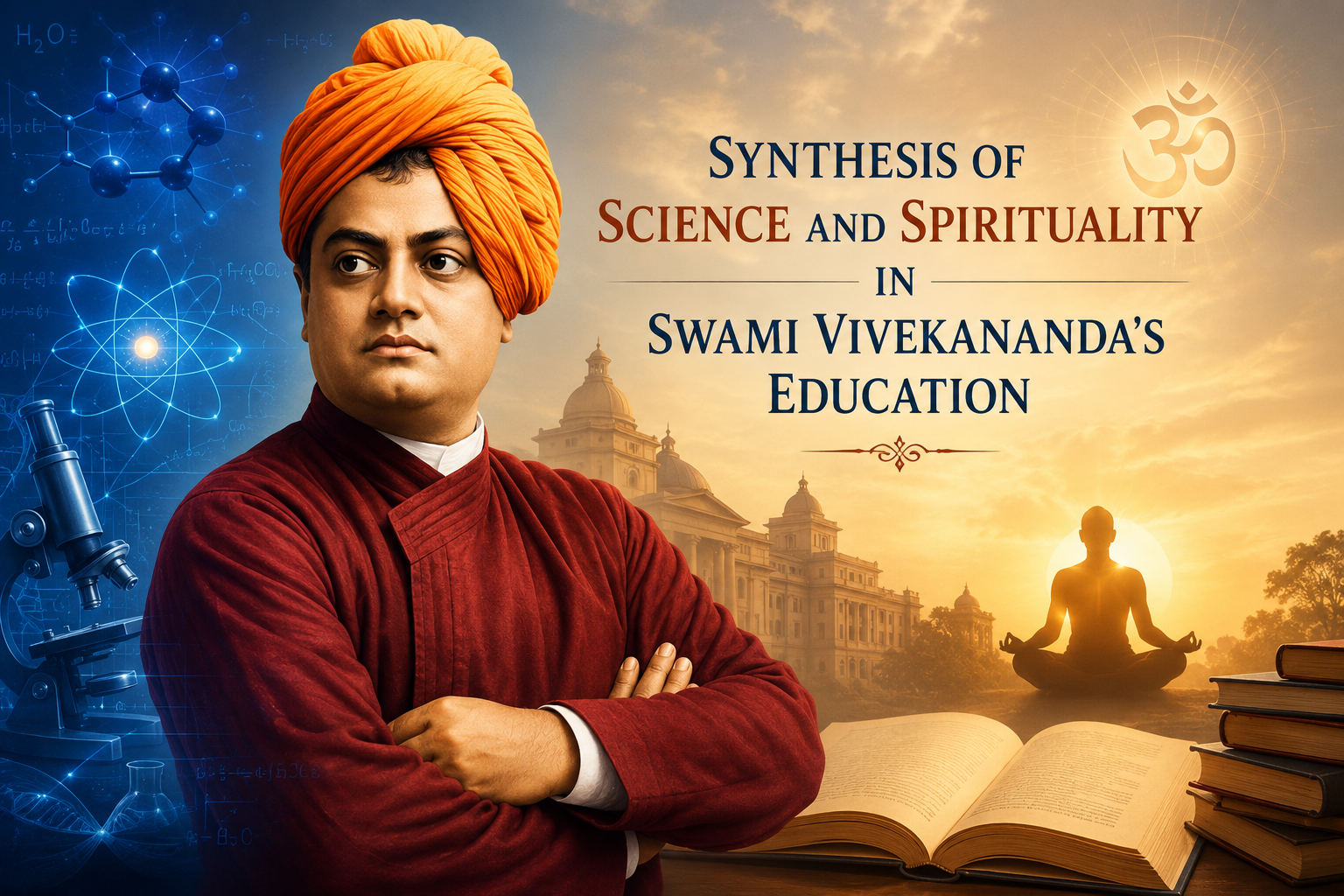
Swami Vivekananda’s life mission was to empower individuals through “Man-making education”, which to him meant nurturing the complete development of a person – mind, body, and spirit. He believed education should go beyond just learning facts and passing exams, and instead help bring out the hidden potential within each learner. For Vivekananda, intellectual growth and spiritual wisdom were intertwined, and he advocated for a balance between the two. At the core of his philosophy was the beautiful synthesis of science and spirituality, which he saw as complementary rather than contradictory, allowing individuals to live more holistic, fulfilling, and purposeful lives.
This paper delves into the very essence of Vivekananda’s idea of Education, proposing an integrated rather than a contradictory approach between Rationality and Spirituality. It explores how his philosophy of education seamlessly blends science and spirituality by addressing four fundamental questions: ‘Who, Why, Where, and When.’ Through an analysis of his teachings grounded in these principles, we will uncover how science and spirituality are not opposing forces but complementary elements that, together, shape individuals capable of meaningfully contributing to both society and their own personal growth.
Keywords: Man-making education, Rationality, Swami Vivekananda, Modern Education, spirituality.
Table of Contents
I. Introduction
II. Science and Spirituality: Complementary, Not Contradictory
III. Swami Vivekananda’s Vision of Education
IV. The Four W’s in the Context of Vivekananda’s Philosophy
A. Who: The Seeker of Knowledge
B. Why: The Purpose of Learning
C. When: The Lifelong Process of Learning
D. Where: The Source of Knowledge
V. Science and Spirituality in Modern Education
VI. Other Sources
VII. Conclusion
Introduction
“We want that education by which character is formed, strength of mind is increased, the intellect is expanded, and by which one can stand on one’s own feet.” While referring to this very quote by Swami Vivekananda, which further delineates the vision of his education that learning was never just about accumulating information, it was about realizing one’s true potential, attaining perfection, and experiencing soul evolution. With this, he questioned the very classical approach to the Education system, which is generally taken as the process of gaining knowledge, mainly for intellectual growth and the development of practical skills.
He theorizes a pragmatic approach to education, with both contemporary relevance (Rationality) and the scope to build on it (Higher consciousness).
Vivekananda himself believed that true education must shape the mind, body, and soul so that human beings may not only control the material world but also their inner spiritual world. In this paper, we will explore the different aspects of the synthesis between science and spirituality, examining their interface in Vivekananda’s vision of education. This exploration will correlate his teachings with four fundamental questions—‘Who,’ ‘Why,’ ‘Where,’ and ‘When’—while maintaining that science and spirituality are not opposing forces but rather essential elements that together shape individuals who can contribute meaningfully to both society and themselves.
Science and Spirituality: Complementary, Not Contradictory
The philosophy of Vivekananda, where he sought to bring the discredited part of academia that was the consciousness of ‘Self’ to the forefront. He believed that education should ignite Self-confidence and Self-reliance in individuals, unlocking the inner qualities that lie dormant within. Swamiji further asserts that education is a state of absolute perfection. He stressed the importance of self-realization, self-reflection, self-judgment, self-control, self-motivation, self-analysis, self-development, self-enthusiasm, self-reliance, and self-liberation, all of which emanate from both formal and spiritual education. His ideas of spiritual education and thinking have their roots in the teachings of the Vedas, Upanishads, and the Gita. Vivekananda believed that only through the quest for spiritual advancement could one foster mental development, character-building practices, national progress, and the formulation of bold, balanced citizens.
He believed that a nation’s greatness is determined by the level of spiritual education it has, not by how many schools, colleges, and universities it has, but by the values, morals, and creativity of its people. Along with this, he believed that character, social, and spiritual development are possible only through spiritual education. Thus, he strongly asserted that the practice of Brahmacharya leads to moral and spiritual growth, resulting in the purity of thoughts, words, and actions. Thus far, we have seen how Swamiji has theorized a synthesized education with contemporary relevance and a philosophical background.
The Four W’s in the Context of Vivekananda’s Vision
Delving further into the idea that Intellect, when supplementing Rationality, leads us to different questions, we find the same questions forming by considering the four W’s—‘Who,’ ‘Why,’ ‘Where,’ and ‘When’—we gain a deeper understanding of how Vivekananda perceived the inseparability of science and spirituality, integrating them into a grand scheme for education.
Who: The seeker of knowledge
Here, we’ll discuss the context of Vivekananda’s philosophy of the Self. He purports that it’s the real Self that always seeks the True knowledge (rational and scientific) to explore the inner self and the avenues lying in the material world. When Vivekananda lived, the science of psychology was still very young, yet his philosophy fully coincided with what science accepts today as a requirement for self-introspection and self-realization. He believed that the seeker, in his quest for knowledge, must embark on both scientific inquiry (the study of the external world) and spiritual disciplines (the study of the inner consciousness).
For example, a defining moment in Vivekananda’s life was his quest for truth, which led him to his guru, Sri Ramakrishna Paramahamsa. When he encountered Ramakrishna, he asked him point-blank, “Have you seen God?” Ramakrishna’s categorical answer, “Yes, I see Him as clearly as I see you,” had a profound impact on Vivekananda. That was the turning point in his life from being a critic to a search for spirituality.
This consciousness, spiritual as it may be, also corresponds to an empirical investigation into human consciousness. Thus, Vivekananda’s own life embodies the intersection of science (in pursuit of knowledge) and spirituality (in pursuit of self-realization). Therefore, the ‘Who’ of Vivekananda’s philosophy of education is both the intellectual self and a spiritual seeker, and acknowledges the importance of developing the mind and soul.
Why: The purpose of learning
Why should knowledge be pursued? For Swami Vivekananda, the answer lies in the search for truth. Truth, in his view, is not limited to the material world but also includes spiritual realization. Scientific knowledge helps us understand nature, society, and the physical universe, while spiritual knowledge enables us to discover our inner self and purpose.
Vivekananda believed that education should combine both dimensions. Knowledge is not merely a means of acquiring facts or achieving material success; it is a path to self-development and service to humanity. His address at the Parliament of Religions in 1893 reflected this vision of harmony between scientific inquiry and spiritual wisdom.
Just as science relies on observation and experimentation, spirituality, according to Vivekananda, is grounded in personal experience rather than unquestioning belief. Therefore, true knowledge emerges when external understanding and inner realization complement each other. The pursuit of knowledge, then, serves a dual purpose: mastering the material world and realizing one’s higher potential.
When: The lifelong process of learning
When is the right time to seek knowledge? For Swami Vivekananda, the answer was simple: learning should never stop. The pursuit of knowledge, whether scientific or spiritual, is not limited to childhood or formal education. It is a lifelong process of growth, discovery, and self-realization.
Vivekananda believed that education goes beyond degrees and certificates. Every experience, challenge, and interaction offers a chance to learn. He emphasized discipline, curiosity, and ongoing effort in both scientific inquiry and spiritual practice. Just as a scientist continues to explore new questions after a discovery, a seeker of truth must stay committed to learning throughout life.
His own life reflects this belief. Even after gaining international recognition at the Parliament of Religions in Chicago in 1893, Vivekananda continued to study, travel, and engage with various intellectual and spiritual traditions. His eagerness to learn allowed him to connect science and spirituality, as well as Eastern and Western thought.
Modern educational theories and neuroscience support the idea of lifelong learning. They highlight the brain’s ability to grow and change throughout life. Vivekananda’s vision suggests that true education is a continuous journey. It involves not only gaining knowledge of the external world but also developing a deeper understanding of oneself.
Where: The source of knowledge
This section of the essay reflects that despite taking into consideration all the aforementioned viewpoints, what remained unquestioned, i.e., what’s the source for that knowledge which we are seeking, and where does it come from? How does it further support Vivekananda’s idea of “Synthesized Education”? Here, Swamiji argued that the two very fundamental sources for true knowledge are-
External (Worldly)- which we come to understand through science and observation. Inner-self (Experience)- which we try to understand through spirituality and self-inquiry.
He saw education as a process that had to cultivate both so that people could not only navigate the material world but also find deeper truths about themselves.
Vivekananda constantly emphasized the necessity of direct experience in both spheres. He believed that people should not accept knowledge on authority or tradition, but should verify it for themselves. In science, it means testing ideas through experimentation. In spirituality, it means self-inquiry and personal practice to reach higher truths. To him, scientific inquiry and religious knowledge were complementary, not adversarial, and each offered a different but equally valid method of knowledge. One of the best examples of this principle is seen in his own life during his travels in India as a poor monk. During these travels, he attentively observed the struggles of people living in poverty, the advancement of science, and the cultural traditions of various communities. The people he encountered from all walks of life made him a firm believer that worldly knowledge and divine wisdom are meant to coincide.
Other Sources
By looking at one of the instances of his life, where he tried to signify the importance of both intellect and the spiritual source of knowledge as two key factors to attain absolute perfection in education. The instance was that, on his trip to the Indian princely states, he noted the stark contrast between prosperity and widespread poverty. He realized that India’s problems could not be tackled by spiritual work alone; economic and scientific development were needed too. It was this perception that led him to advocate integrating technical and vocational instruction with spiritual instruction.
He established the Ramakrishna Mission, which taught not only vocational skills and moral instruction but also idealized his vision of a balanced system of education. This further laid the foundation for the reforms in the Indian society, not based on the Western philosophy alone, but by incorporating the Vedic knowledge as well, further making it relevant for both Rationality (Western philosophy) as well as Spirituality (Indian philosophy) for the Moral as well as a progressive development of the Indian society. It not only provided a comprehensive way of learning but also tried to bridge the gap between the Western and the Eastern intellectual patterns without demeaning any aspect of either as irrelevant and backward
Conclusion: A Balanced Vision For Modern Education
Swami Vivekananda’s approach to education harmoniously blends science and spirituality. Looking at the basic questions of Who, why, Where, and When, we can see how he synthesized these two seemingly disparate areas into a single philosophy of education. He not only synthesized but also presented it with a modern outlook that is contemporary and relevant. Education for Vivekananda was more than mere academic excellence; it was the development of the entire individual—mind, body, and spirit. He thought that scientific knowledge should be supplemented because both are required for the growth of human potential and a successful life. His philosophy encourages us to transcend conventional education and to embrace a learning process that cultivates mental acuteness, moral valor, and spiritual insight.
Author: Siddharth Pandey — Student, Department of Sanskrit, Sri Venkateswara College, University of Delhi